In the summer of 2007, following the episodic release of Sam & Max Season One (aka Sam & Max Save the World), we celebrated “The Summer of Sam & Max” by releasing behind-the-scenes content in the lead-up to Season Two’s premiere. A four-part article delving into the series’ history was part of that promotion.
To celebrate the season’s 20th anniversary, we’ve reconstituted it with help from backups on the Internet Archive. (Historical preservation is important, kids!)
The History of Sam & Max
Part 1: The Early Years
Part 2: The Golden Era
Part 3: Sam & Max Hit It Big
Part 4: After Darkness Comes the Light
Part 1: The Early Years
Many passionate tales are born out of sibling rivalry. Cain and Abel. Romulus and Remus. Sam & Max: Freelance Police.
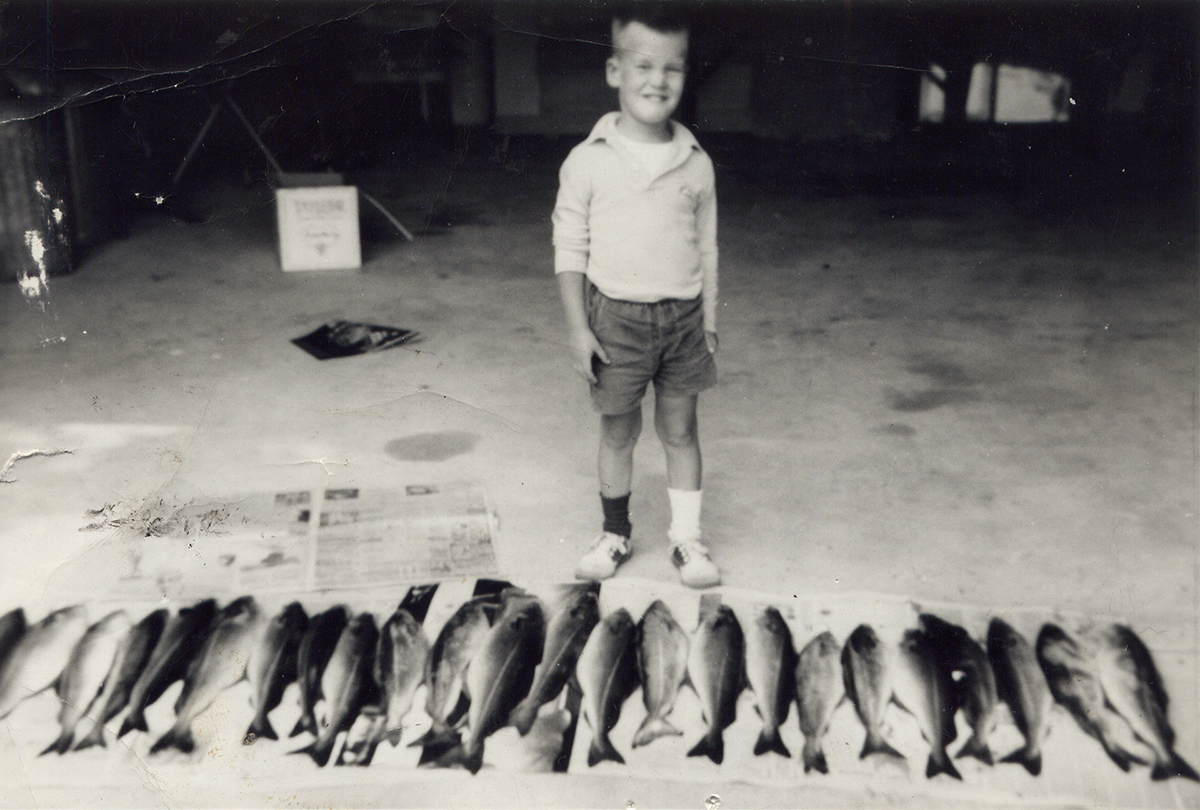
Above: Steve Purcell, age 5. That’s a lot of fish.
This particular tale starts way back in the disco era, when budding artist Dave Purcell invented a comic about a dog and rabbit team of detectives, Sam and Max. Dave would often leave unfinished comics lying around the house.
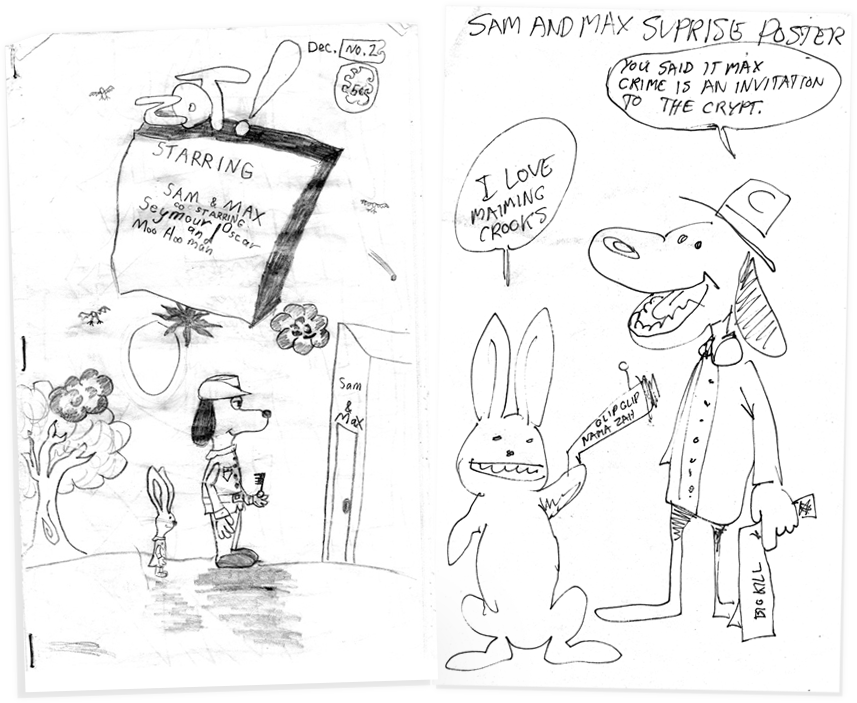
Above, left: Rare glimpse of Dave Purcell’s Sam & Max in ZOT! #2, costarring the enigmatic Moo Hoo Man.
Above, right: Steve’s rendition of Dave’s characters, drawn to piss off his brother.
To torture him in the way that only siblings can, older brother Steve would finish the comics as parodies of the stories Dave was trying to tell, with Sam & Max messing up each other’s names, shooting at each other, and making fun of how they had been drawn.What started as a prank evolved into something bigger when Steve went from making fun of his brother’s Sam & Max comics to writing his own.
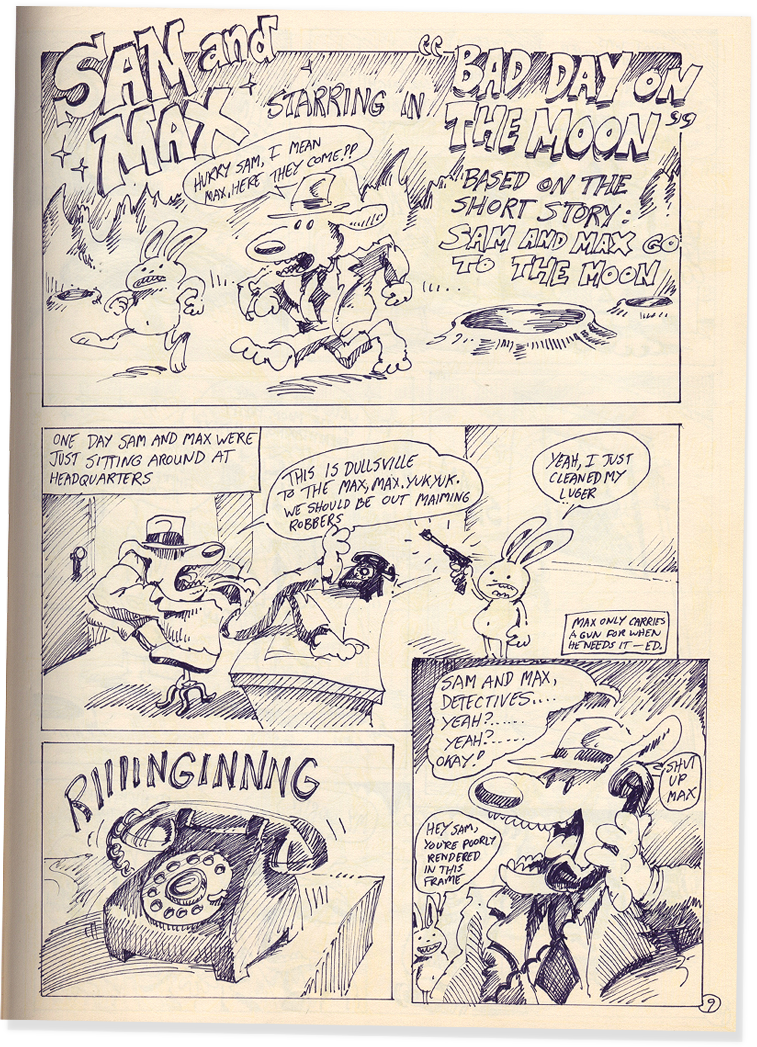
Above: Sam & Max’s first trip to the moon, circa 1978.
Ultimately Dave relinquished the characters, and one birthday he signed them over to Steve in a handwritten contract, giving Steve the freedom to develop the Freelance Police into the duo we know today.
Much of Sam & Max as we know it was born out of Steve’s personal experiences. Steve had pet rats and invented a game called Fizzball with his friends, both of which became Sam & Max staples in later years.
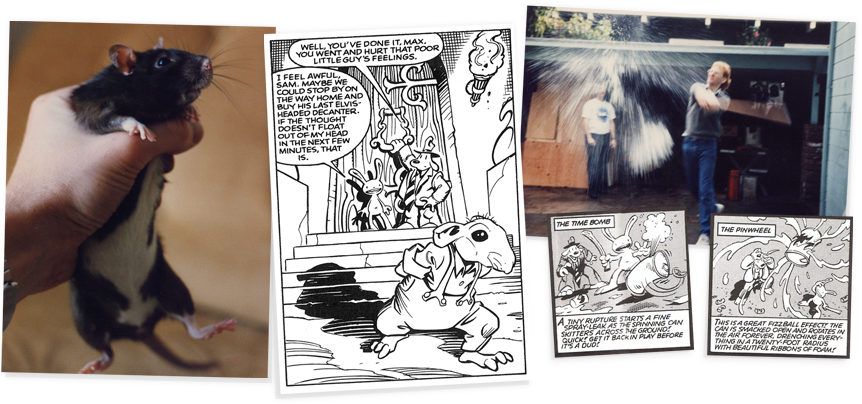
Above, left: Ernie the pet rat, who inspired the rats in Steve’s comics. Ernie has gone to the rainbow bridge, but his legacy lives on.
Above, center: A rat from Bad Day on the Moon (the second one).
Above, right: Art Adams swings a bat in the inaugural game of Fizzball. Adams went on to illustrate zillions of comics. Mike Mignola (of Hellboy fame) was also involved in the invention of the game.
In 1980, the first Sam & Max comic strips appeared in print in the weekly newspaper of the California College of Arts and Crafts, where Steve went to school. The banter and storyline is pure Freelance Police, but visually, the characters hadn’t quite evolved into the Sam & Max the style we’re used to.
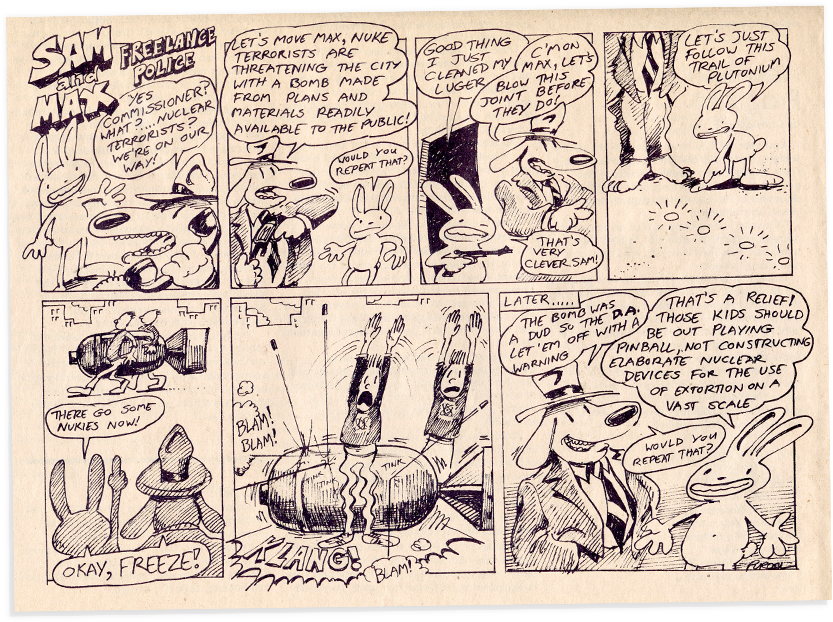
Above: The first published Sam & Max strip, drawn the night before deadline, 1980.
Let’s jump ahead to 1987, the year the first Sam & Max comic book was published. What happened in the interim? “The book came about because Steve Moncuse, creator of the black and white comic Fish Police, was having a lot of success publishing that book,” Steve says. “He wanted to include a second title and asked if I would want to do a comic length Sam & Max story. I had spent the time between art school and the first Sam & Max book doing freelance illustration, much of it for sword-and-sorcery game magazines and covers for primitive computer games. I had penciled a bunch of forgettable Marvel comics but had never written, penciled and inked my own comic book before that.”
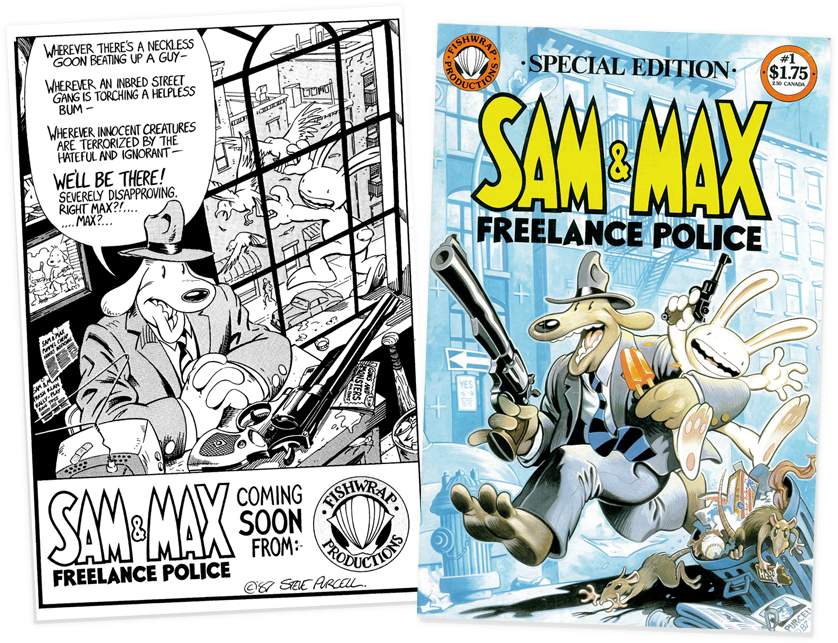
Above, left: An ad for the (then) upcoming first full fledged Sam & Max comic book, as seen in a 1987 issue of “Fish Police.”
Above, right: The cover of Sam & Max #1. Find it today on eBay for too much money.
Note from Steve: “Monkeys Violating the Heavenly Temple comes from the name of a firework. It felt strangely appropriate if you can make the case that Sam & Max are the Monkeys invading the cult leader Fritz Nunkie’s sacred sacrificial volcano god alter. And it sounds funny.”
Steve took the plunge, and Sam & Max Freelance Police #1 was published in 1987, featuring their first full-length comic adventure, “Monkeys Violating the Heavenly Temple.” The 32-page comic introduces the familiar Sam & Max universe that has continued to expand in the twenty years since, including appearances by Flint Paper, Mack Salmon, the DeSoto, and many of Steve’s signature rats.
In the comic — which incidentally involves neither monkeys nor a heavenly temple — the Freelance Police chase down a purse snatcher, pop into an eclectic version of the Philippines complete with kangaroos, the Eiffel Tower, and a street vendor selling weasels on a stick, confront a mob of volcano-god worshipping cult members, almost get their guts ripped out but manage to save the day anyway, then head back home on an airplane that gets hijacked by a guy in a clown mask. All in a day’s work for the dog and rabbity-thing, and a harbinger of even weirder stuff to come.
Part 2: The Golden Era
In the late eighties, Steve went from being a freelance illustrator to a full-time animator at LucasArts. “It must have been 1988 since that’s the year Zak McKraken came out,” Steve says. “I was hired, and laid off right away when the project I was hired for got cancelled. They brought me back to paint the Zak cover and then I rolled onto Last Crusade.” During this time, Steve continued to work on Sam & Max on the side, including three additional comic books. He also leant his painting talents to LucasArts, creating cover art for game boxes including Maniac Mansion and the first two Monkey Island games.
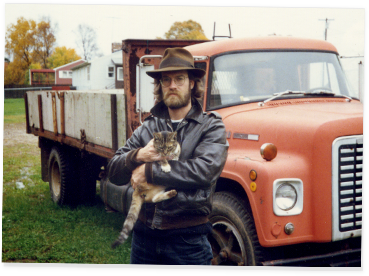
Above: Steve Purcell, soon after joining LucasArts (“LEC”).
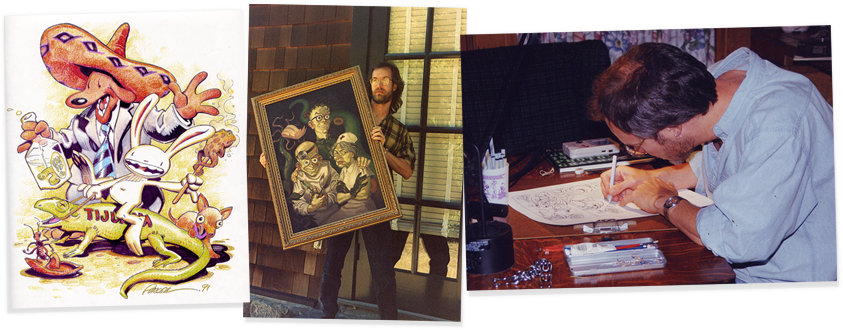
From left to right: A 1991 convention piece; posing with the Maniac Mansion back cover; working on “Beast from the Cereal Aisle.”
So how did Sam & Max end up as characters in one of LEC’s games? “I was working on the “On the Road” comic when I first started there. People in the company got to know the characters and I made little animated walk and talk cycles of Sam & Max and an office background for Ron Gilbert’s new SCUMM programmers (called Scummlets) to practice with.”
Then came the Adventurer, a quarterly newsletter LucasArts started to let their customers know about upcoming games and company news. The powers-that-be approached Steve about contributing a comic to the publication and Steve agreed, on the condition that they could be Sam & Max comics. The rights to Sam & Max remained with Steve, but the strips born out of this arrangement would forever link Sam & Max to LucasArts and the games they released in the 1990s — considered by many the “golden era” of adventure games.
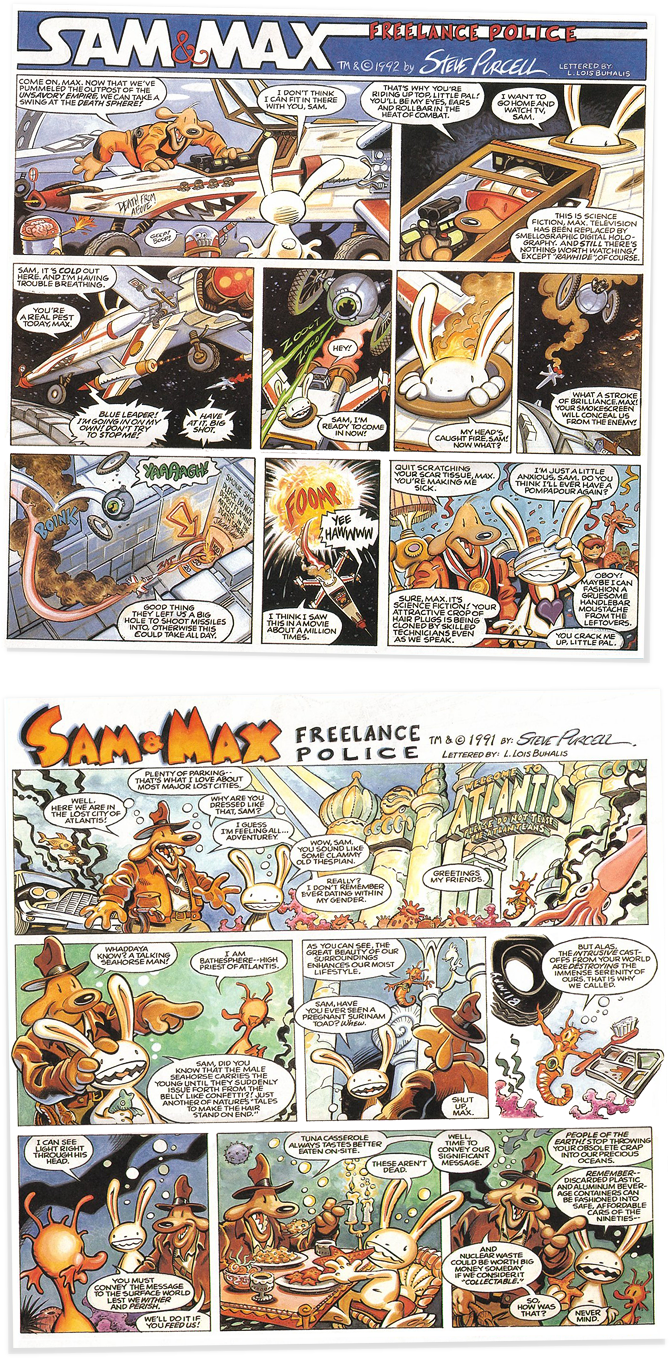
Above: A few Sam & Max strips for LucasArts’ “Adventurer” magazine.
The fan reaction was good, and the relationship evolved further in 1993 when LucasArts offered to make a game out of the characters. Sam & Max Hit the Road was inspired by “On the Road,” which featured a road trip through appallingly gaudy Americana and the duo’s first bout of highway surfing. The game was co-designed by Steve, his future wife Collette Michaud, Mike Stemmle, and Sean Clark, and was QA tested by some upstart named Dan Connors.
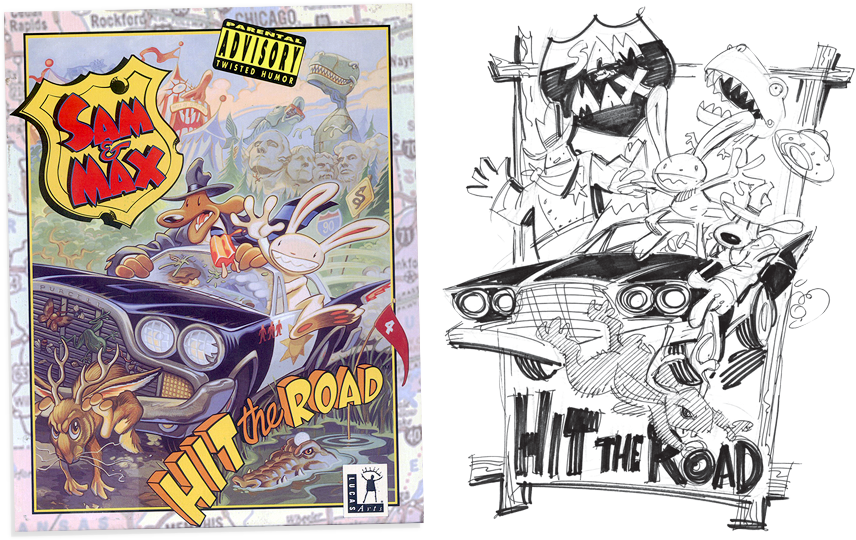
Above: The box art for Sam & Max Hit the Road, along with a slightly different treatment which never made it off the page.
In 1993, smack dab in the middle of Hit the Road production, Steve and Collette got married. Sam & Max made a special appearance at the ceremony.
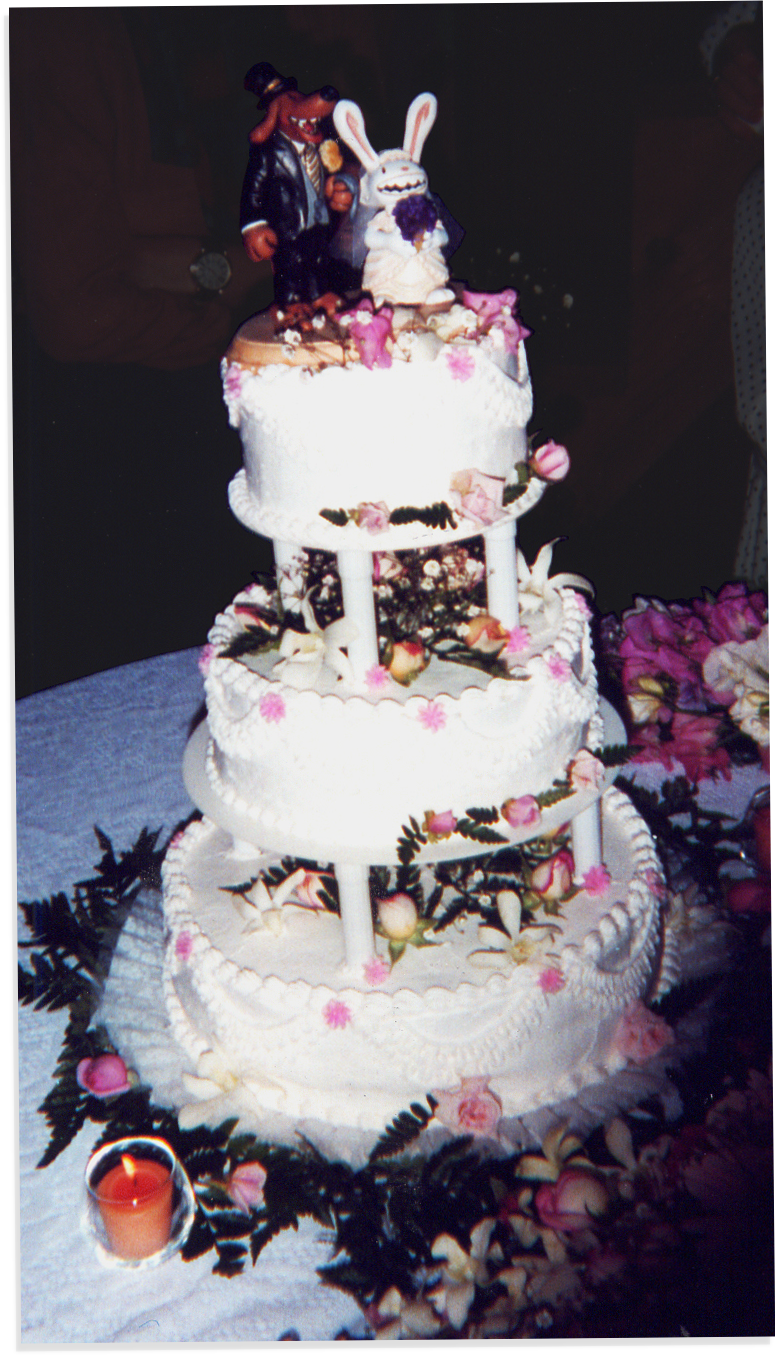
Above: Steve and Collette’s wedding cake. At least now we know which way Max swings.
An Interview with Steve Purcell and Mike Stemmle
Want to know what it was like working on Hit the Road? So did we! Unfortunately Dan went on vacation before we could extract any intimate details from him (or maybe he did it on purpose), but co-designers Mike Stemmle and Steve Purcell still stepped up to the plate to tell us their fond (and not so fond) memories of Hit the Road production. Without further ado…
What’s your favorite part of the game?
Mike: That varies depending on the mood I’m in. Sometimes, it’s the extravagant lunacy of the “King of the Creatures” song, which was joyously superfluous to the actual game, and would be one of the first things cut in today’s penny-pinching projects. Other times it’s the some of the weirder bits of game play, like Gator Golf or the Cheesy Virtual Reality section. And sometimes, it’s the music. Good golly, do I adore that score.
Steve: I like the carnival because it has all the elements that feel so much like part of Sam & Max’s world. Larry Ahern’s hilarious Cone of Tragedy animation, the obscure Tunnel of Love puzzle, a moleman, the Wak-A-Rat mini game. And the excruciating walk cycle of the Siamese twin Kushman Brothers which probably took me about a week to animate.
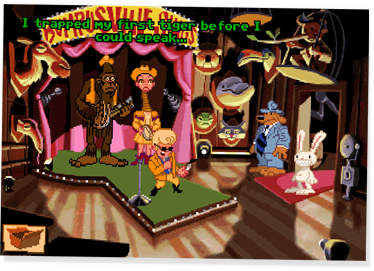
Above: Mike Stemmle’s favorite part? Sometimes.
Tell us something funny that happened during Hit the Road production.
Mike: At one point during the production, when we were all a bit groggy, I actually told Steve Purcell that he was the “god-king” of the game. To this day I have no flippin’ idea what the hell I was talking about.
Steve: I don’t remember Mike saying that or why he might have but I assume he was uncharacteristically hammered or denied oxygen. However, it’s a terribly flattering sentiment. I always thought it was funny that one of our animators Jesse Clark just became enamored with the look of Sam in his shirtsleeves. He thought he looked so cool and loved drawing him like that it was almost like a man-crush. Can’t say I’m not impressed by the look as well.
How about something terrible that happened?
Mike: I got two things. One Saturday I looked out my corner office’s window, and noticed that Oakland was on fire. Little did I know that my uncle’s house was burning down. There was also the horrible time that Sean and I found out that an eager young programmer had worked herself into a raging case of carpal tunnel syndrome rather than give the appearance of slacking off. That’s some heavy karmic debt right there, man.
Steve: Larry Ahern stuck one of my “Protected by Sam & Max” decals in his truck window and days later the truck was stolen and gutted. I put one in the window of my Acura and an out-of-control Audi plowed into it in front of a comic book shop.
Of the game’s roadside attractions, which is your favorite?
Mike: The World of Fish is a nearly my favorite, because I’ve since had the pleasure of visiting its real-life inspiration (the Freshwater Fishing Hall of Fame in Hayward, Wisconsin). But today I’m going with the World’s Largest Ball of Twine, ’cause it’s a fully-realized combination of puzzles, characters, music, and out-and-out weirdness. It’s also got one of the better “the designers wrote their way into a hole, so here’s a funny gag to make up for it” bits I’ve ever been a part of.
Steve: Years later whenever someone tells me they got stuck in the game, I know that they’re going to say at the Ball of Twine. I do like all the stuff that going on there with the elevator and the fish deck and spoon bender. I remember how groundbreaking we thought we were by doing a 3D tram car and then the helicopter with rotating fish animation.
In the game there’s a key location called Frog Rock which came straight from my childhood. Some adult relative talking up Frog Rock all day on a car trip. When we got there it was like, “That’s it? It doesn’t even look like a frog!”
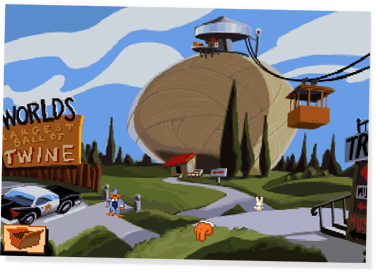
Above: Home of more stuck gamers than any other tourist trap.
What was it like working at LEC in the early ’90s?
Mike: It was a lot like being in the middle of the Summer of Love, man, only without the free love, easy access to mind-expanding drugs, or the really bitchin’ soundtrack. Okay, scratch that — it was nothing like the Summer of Love.
In truth, it was intense, fun, and completely out of control. Just about anyone could get a million-dollar project green-lit with little more than a five page overview of a hint of a scintilla of an idea for a game. On top of that, no one seemed to have the slightest clue what made a game a hit, so everyone assumed that just about ANY game could be a hit, if it was pure of heart and cool of idea. Thank the Maker we finally got some focus groups, market testers, and industry trend forecasters into the mix, or who knows how long that kind of unbridled creative insanity might have continued?
Steve: On any of the games during that time it almost seemed like it was too much trouble for any executive tampering. We felt pretty free to go off and make fairly ridiculous decisions without anyone getting in the way. I mean, even in Last Crusade, when Indy drinks from the wrong grail, they let me animate this bombastic explosion. Indiana Jones turns into a skeleton, his jacket puffs out and his head sails off into the holy water bowl. I don’t think you’ll be seeing stuff like that in the most recent installment (probably for the best).
Any fond Sam & Max memories separate from the games that you’d like to share?
Mike: I keep the Sam & Max strip that Steve did for my Afterlife game in my office. It’s one of my happiest possessions. I also get a chuckle every time I think of Steve and Collette’s wedding cake, in which Max’s gender (or perhaps his orientation?) was finally revealed in all it’s bridal gown-wearing glory.
Steve: I’m fond of the time the married couple approached me at a convention and told me that they played Fizzball (a Sam & Max game where beer cans are swung at and exploded with an axe handle) at their wedding. They told me they had the axe handle engraved with their wedding date. I recently I got a request to design a Max tattoo for a couple who are celebrating a 20th anniversary. What is about Sam & Max and marriage? Maybe Sam & Max are the ultimate enduring couple.
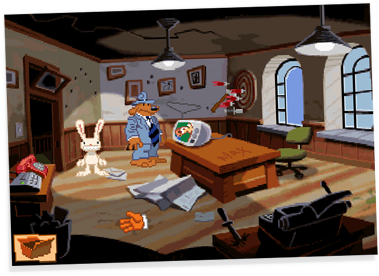
Above: The office, 14 years ago.
Part 3: Sam & Max Hit it Big
(based on the short story “Sam & Max Go to Hollywood”)
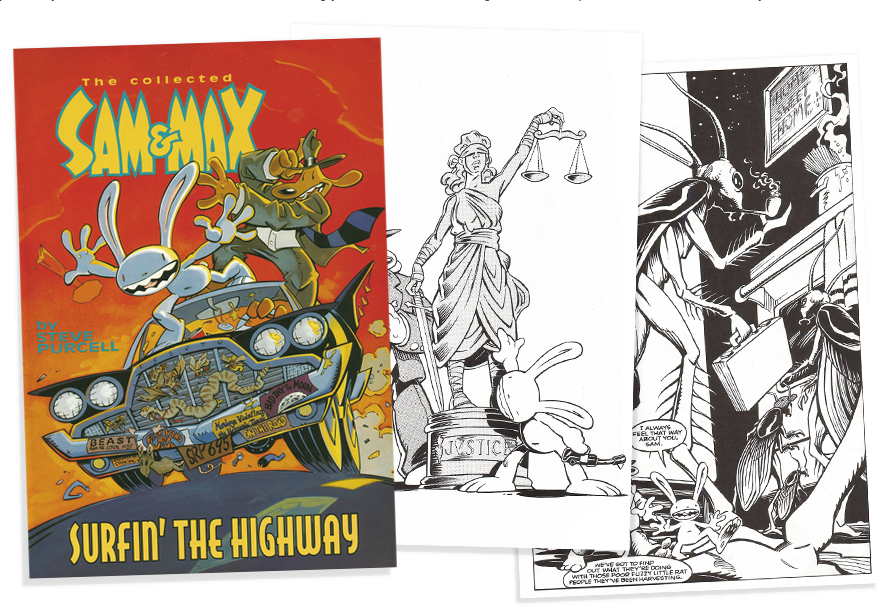
By 1995, Steve Purcell had published four Sam & Max comic books and enough Adventurer appearances and one-offs to put together a complete trade paperback collection, Surfin’ the Highway. The book features six full-length stories, 24 color pages, and four fold-out pages with double-wide features such as the official On the Road board game.
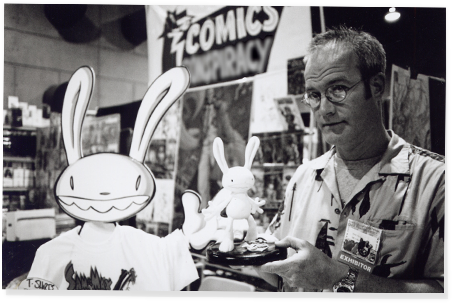
Above: Steve at Comic-Con with everyone’s favorite lagomorph.
When Surfin’ the Highway debuted in 1995, the 154-page paperback sold for $12.95. A signed, numbered hardcover special edition was also released. With a second printing in 1996 the price tag increased to $15.95, and sometime in the late 90s the price skyrocketed as the book became increasingly harder to find. It now goes for a couple hundred dollars on eBay.
Just before the onset of this frenzy, the duo stumbled onto an entirely new (and surprisingly mainstream) form of media: the Saturday morning cartoon. Dan Smith, a longtime story editor at Nelvana Animation in Toronto, was a fan of the comics and had been a constant champion for the idea of Nelvana developing a Sam & Max series. Steve and Dan worked together to block out ideas for the episodes and spent hours on the phone hashing through scripts.
The kids’ show format was a challenge because Sam & Max’s brand of humor had to be geared more “family friendly.” Guns were a big no-no and language was carefully moderated, so Steve made it his mandate to advocate for the “weirdness quotient.” Steve remembers, “One of my favorite gags was an episode [ed: “They Came From Down There”] where a giant mutant Muskie removes the top of Max’s skull leaving his brain exposed. Sam yells out from across the room, ‘Quick! Press down on the medulla oblongata! Five bucks says he smells burnt toast!’” Steve was pleased that Sam & Max maintained some semblance of their moral ambiguity. Says Steve, “People would always come up to me and say ‘It’s too bad you had to soften the characters for kids,’ and then in the next breath they were like, ‘And I can’t believe they let you do THAT!’ referencing some dodgy gag.”
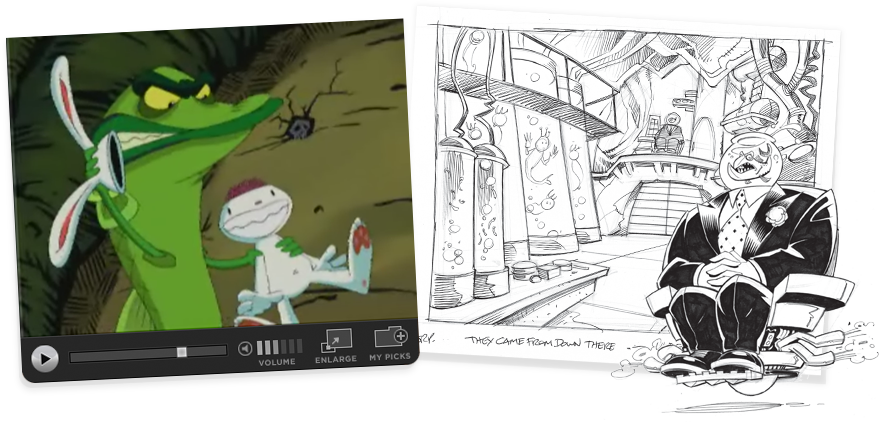
Above, left: Watch the medula oblongata joke from “They Came From Down There” on YouTube.
Above, right: Some of Steve Purcell’s concept art from “They Came From Down There,” including Mack Salmon!
Steve wrote gags for each episode and penned a few complete episodes himself, including, “Little BigFoot,” “The Friend for Life,” “Christmas, Bloody Christmas” and an adaptation of the comic book story “Bad Day on the Moon.” “Bad Day on the Moon was the one time we tried to adapt one of the comic stories,” Steve recalls. “It became this big unwieldy episode that we kept whittling back down to size. From then on we decided to just create new stories for the show instead of trying to make one thing into another.”
The show aired on Fox Kids for the 1997–98 season. It won a Gemini award in Canada for best animated series and made the top ten in ratings that season. But a shake-up at the network put a new president in charge of programming, and at the eleventh hour Sam & Max was not renewed for a new season.
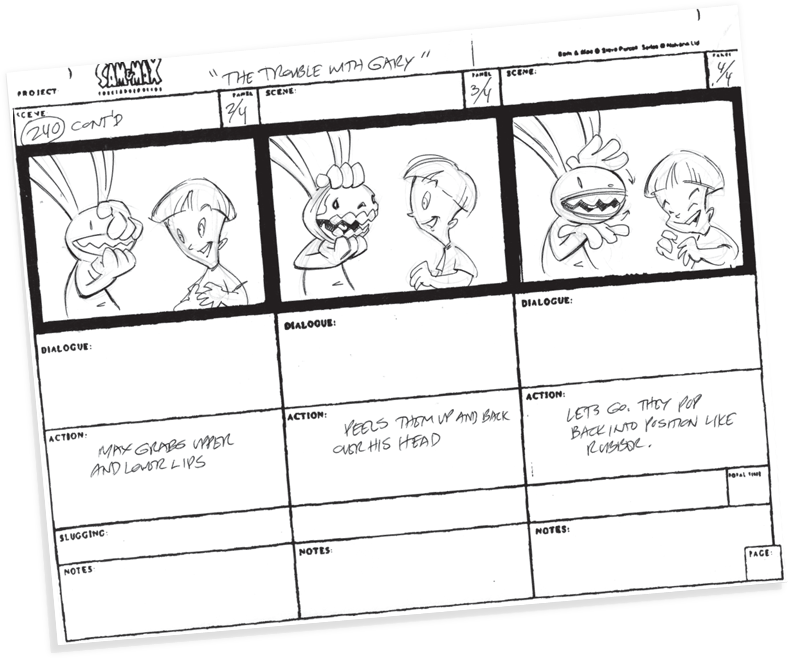
Above: One of Steve’s storyboards for a scene in the animated series episode “The Trouble With Gary.”
Part 4: After Darkness Comes the Light
The years between the animated series’ cancellation and the debut of Sam & Max Season One make up a period many Sam & Max fans would prefer not to remember. False starts and projects that never came to pass dashed the hopes of eager fans, used to the semi-regular freelance police fix they’d come to expect all through the 1990s. The biggest blows came in the form of two games.
The lesser known of these projects, entitled Sam & Max Plunge Through Space, was born at Infinite Machine, a small startup founded by ex-LucasArts employees. The story was one Steve had come up with soon after finishing Hit the Road, and Chuck Jordan (of Curse of Monkey Island and Abe Lincoln Must Die notoriety) was involved in the endeavor. Since Chuck now works full time at Telltale, it was fairly easy to walk across the room and ask him some questions about this never-released gem…
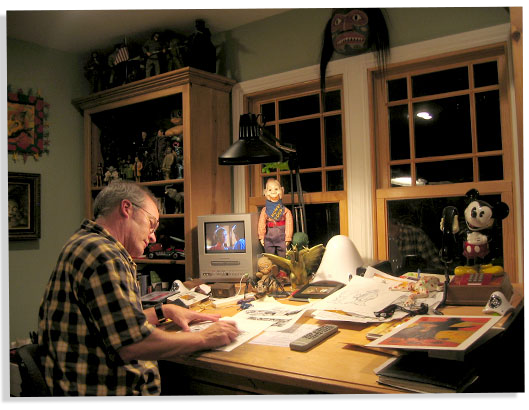
Above: Present day Steve Purcell, at home in his studio.
An Interview with Chuck Jordan
How were you involved in the Infinite Machine game?
Chuck: I was in charge of the pitch/design document. Steve came in with a complete story and concept art for the settings and characters. A team of us would meet weekly for brainstorming sessions over scenes and new characters and gameplay ideas, and then I’d go and turn those ideas into an excessively dry and long-winded Word doc.
Looking back on that game, what was your favorite thing about it?
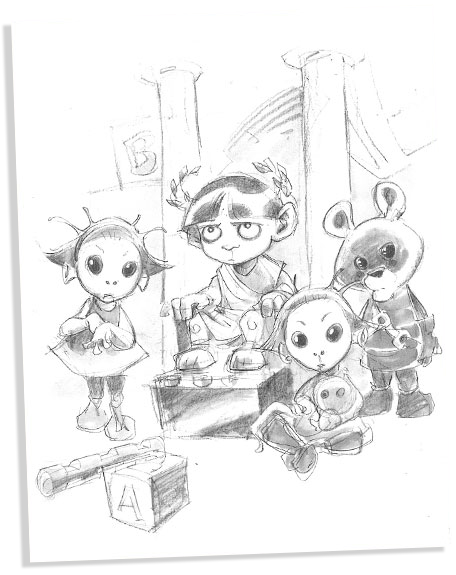
Chuck: Realistically, I think I had more fun at the brainstorming sessions than anyone would’ve had with the actual game. I’d been a fan of Sam & Max since college, so getting to add something to that was a blast. One of my most prized possessions is a concept sketch Steve did of characters that came from those meetings: Span’qee, the tyrannical leader of a children’s play area underneath an alien casino. It was a parody of an episode of “Star Trek” about a bunch of abandoned kids who could summon a “friendly angel” by pounding their fists and chanting a rhyme. In the game, the idea was that the kids had been waiting for their parents so long that they’d developed their own civilization, and Sam & Max would have to use the alien kids’ telekinetic powers to open up areas of the casino underground.
This game was going to be action/adventure. Do you have any thoughts about how the playing experience would have been different from the story-driven Sam & Max games that have been made?
Chuck: It was a lot heavier on “adventure” than “action.” It was intended to be more of a hybrid, giving you the story and characters of a point-and-click adventure, but with the pacing of a 3D platformer. You’d have controlled Sam directly, moving around environments about the size of a FPS level, solving item-based puzzles and getting into dialogue exchanges. Enemies would wander the level, so you could always go back and shoot and/or beat them up. (I remember that we spent a good bit of time trying to figure out how to do shooting without over-complicating the targeting interface, before we remembered that it’s Sam & Max, and accuracy is kind of irrelevant.) We were hoping to have a platformer without shallow characters or annoying jumping puzzles, and an adventure game without the feeling that nothing happens when you get stuck. The best part of having a pitch go unpublished is that I can say that we solved every problem, and it would’ve worked perfectly, if only it had gotten made.
During one of the earliest brainstorming meetings, Steve just casually mentioned the idea of a “Freelance Police Academy,” and that idea stuck with me as more of an action/adventure game. I’ve decided that no matter what it takes, I WILL see that game made before I die.
Is there anything else about the game you’d like to share?
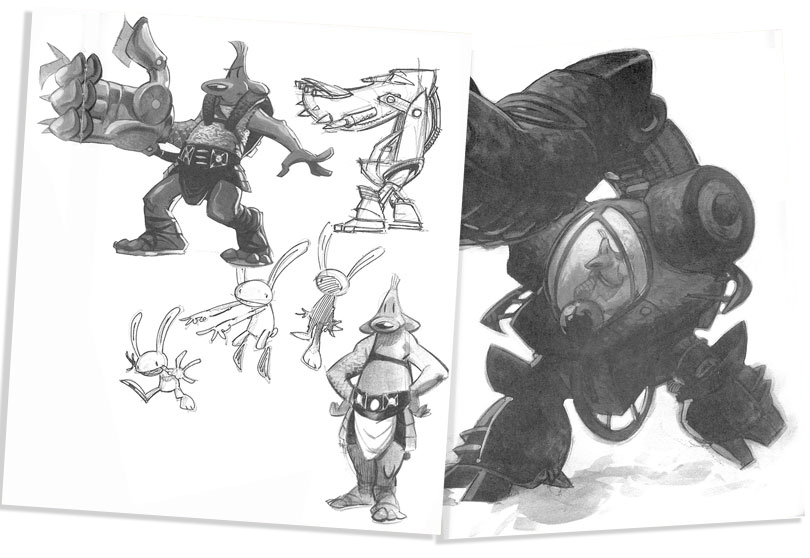
Chuck: I’m still hoping some of the ideas can be repurposed into future Sam & Max games, so I don’t want to spoil them all. But our idea for boss fights was solid gold. We wanted to give each area a mini-game climax, but without making it too platformer-like. Steve came up with the idea of thumb-wrestling duels, which turned out to be a perfect fit for the original Xbox controller. A big “Mortal Kombat”-style build-up with rotating cameras, a cheering crowd, and blasting a techno version of the Rolling Stones’ “Under My Thumb.” I still weep at the thought of it.
Stop shaking your thumb — err, fist — at the marketplace realities that caused Infinite Machine to close its doors before Sam & Max Plunge Through Space could be made, and take a deep, cleansing breath. It gets worse before it gets better.
The second major project to fall through — and the one that most Sam & Max fans will forever associate with the day their faith in humanity died — was back at LucasArts where it all began. “I believe it was shortly after the news that Infinite Machine was folding up that I got a call from LucasArts,” Steve says. “The idea of revisiting Sam & Max was floating around LucasArts but they didn’t want to approach me as long as Infinite Machine’s game was alive. Since I already had a job at Pixar, the idea that Mike Stemmle (Hit the Road co-designer) would be leading the project made it even more appealing.”
Sam & Max: Freelance Police was announced at E3 2002 with a trailer showing off the characters’ move to 3D. Rather than one long road trip, this game was designed as a series of six loosely related cases. In addition to Mike Stemmle, who was in charge of the game’s creative direction, other project leads included Dan Connors and Kevin Bruner. Steve worked on the game as an advisor: “I was the guy to consult on everyone else’s smart, funny work. Actually I worked most with Mike on the stories for the individual cases and the overarching uberstory, as he liked to refer to it. I also managed to squeak out some character concepts along the way.”
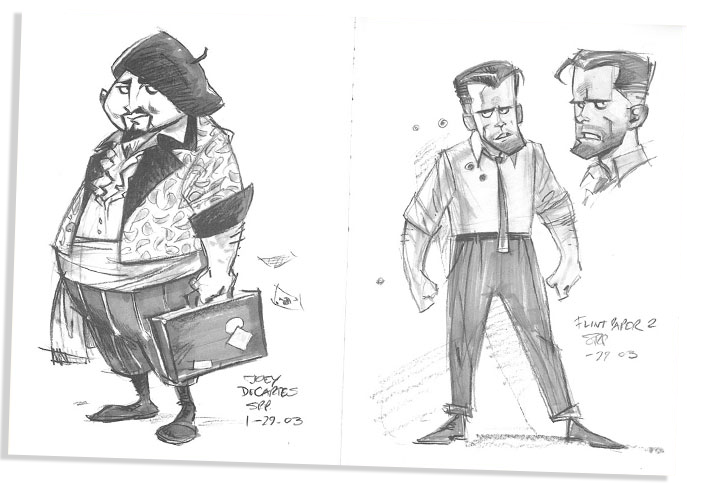
Above: Some concept art from Freelance Police
Although LucasArts had largely moved away from the roots that made its adventure games so popular in the 1990s, Mike recalls that working on Freelance Police was like old times. “Funny things were always happening. During one meeting, the artists were showing off the latest animations and characters from an episode revolving around a ‘Burning Max’ festival, which featured, among other things, copious nudity. Unbeknownst to me, one of the many buck-naked models crafted by our cheeky modelers was none other than yours truly. Now, back then I was a lot of things, but an attractive naked man I was not. Soon afterwards, a video clip of my cartoonish naked form doing a sultry dance on the grounds of the festival was making its way through the halls of LucasArts. Although I’ve since tracked down and obliterated most of these videos, I keep one on my hard drive at home as a reminder me to stick with my diet.”
Steve has his own fond memories of the production. “Once I had submitted a notes pass on one of Mike’s scripts. He emailed me that he read one joke out of context and didn’t think much about it but once he figured out where it fit in the game he nearly horked milk out his nose. That pleased me quite a bit,” Steve says. “I loved receiving funny animation cycles of this or that like an endless jumping Max. I’d keep them on my laptop and surreptitiously show them around, proudly, as if they were baby pictures.”
Production seemed to be going well, but in March 2004, Freelance Police was unexpectedly cancelled. “I can still remember the chill that went down my spine when our marketing department informed me that the entire population of European adventure game players had, over the course of less than three months, died,” says Stemmle. “You’d think a massacre of such proportions would’ve been reported more widely.” LucasArts officially attributed the decision to “current marketplace realities” and “underlying economic conditions” and, in one fell swoop, caused Sam & Max fans around the world to weep. Openly.
Steve remembers getting a cryptic email from Mike asking him to stop by the office. “Of course that was right at the moment when things had seemed to be cruising along without a hitch. That’s how that kind of thing always seems to go.” So how did Steve feel about the cancellation? “I’ve worked on projects that have gotten cancelled before so I think I took it pretty well. I felt worse for the crew, who had a lot more of their time invested than me. I knew that the public might automatically assume the game had been in trouble so I issued an official comment to let fans know the game itself was in good shape — that the decision was strictly a marketing choice.”
The fans weren’t willing to give up Freelance Police without a fight. They mobilized and ultimately circulated a 32,000 signature petition to LucasArts to express their disappointment over the cancellation. A German company called Bad Brain claimed to be in talks with LucasArts to buy the nearly finished game, but nothing came of it. The future of a new Sam & Max game looked bleak.
Meanwhile, Dan Connors and Kevin Bruner, who left LucasArts soon after Freelance Police was cancelled, were busy setting up shop at Telltale, with the idea of delivering games episodically over the internet. In the summer of 2005, LucasArts’ rights to make a Sam & Max game expired, and Steve started talking to Telltale about starting fresh. In September the deal was inked and announced, to the cautious optimism of thousands of fans, and in December, Sam & Max took their first tentative steps back to life in the first of a series of webcomics inked by Steve and hosted on Telltale’s website. The ongoing series, which went on to be nominated for an Eisner award in 2007, started out in the cemetery behind Kilpeck Church in England with Sam & Max clawing their way back from an untimely burial.
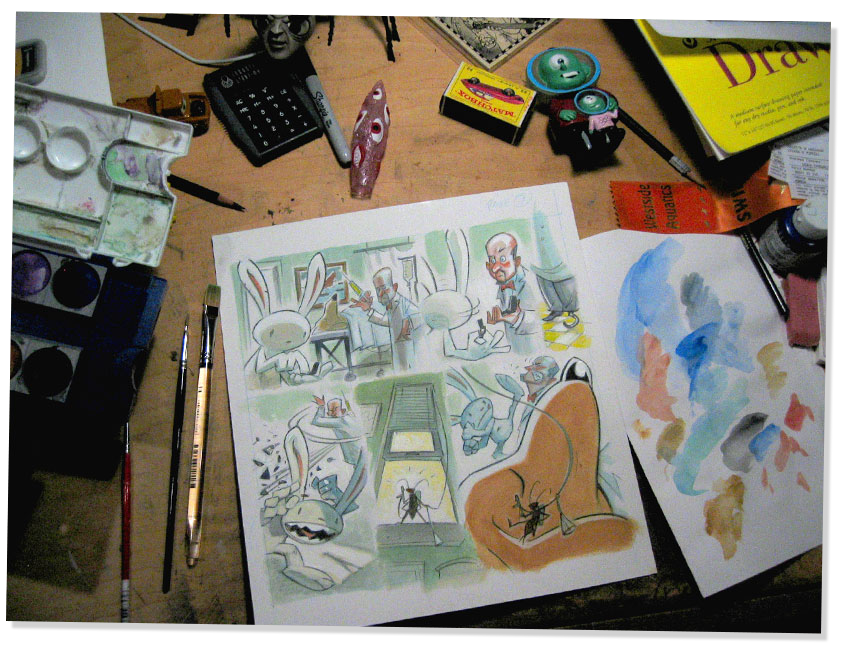
Above: The Sam & Max webcomic, in progress!
And the rest, as they say, is history. Sam & Max Season One debuted in the fall of 2006 to fan elation and critical acclaim. The series had six episodes that ran through May 2007. Then in June, Steve and Telltale announced that to commemorate the 20th anniversary since the first Sam & Max comic’s publication — and to restore faith in humanity to every last heartbroken fan — the fiercely sought Surfin’ the Highway comic collection would be returning to print. More episodic Sam & Max games are currently in development. And the future’s wide open, because as long as there’s a crazy guy named Steve Purcell coming up with new ideas and crazy fans who are dying to hear them, the world will never see the end of Sam & Max.